[ENCRYPTED REPORT: SIPHONED TRUTH]
I. PUBLIC NARRATIVE
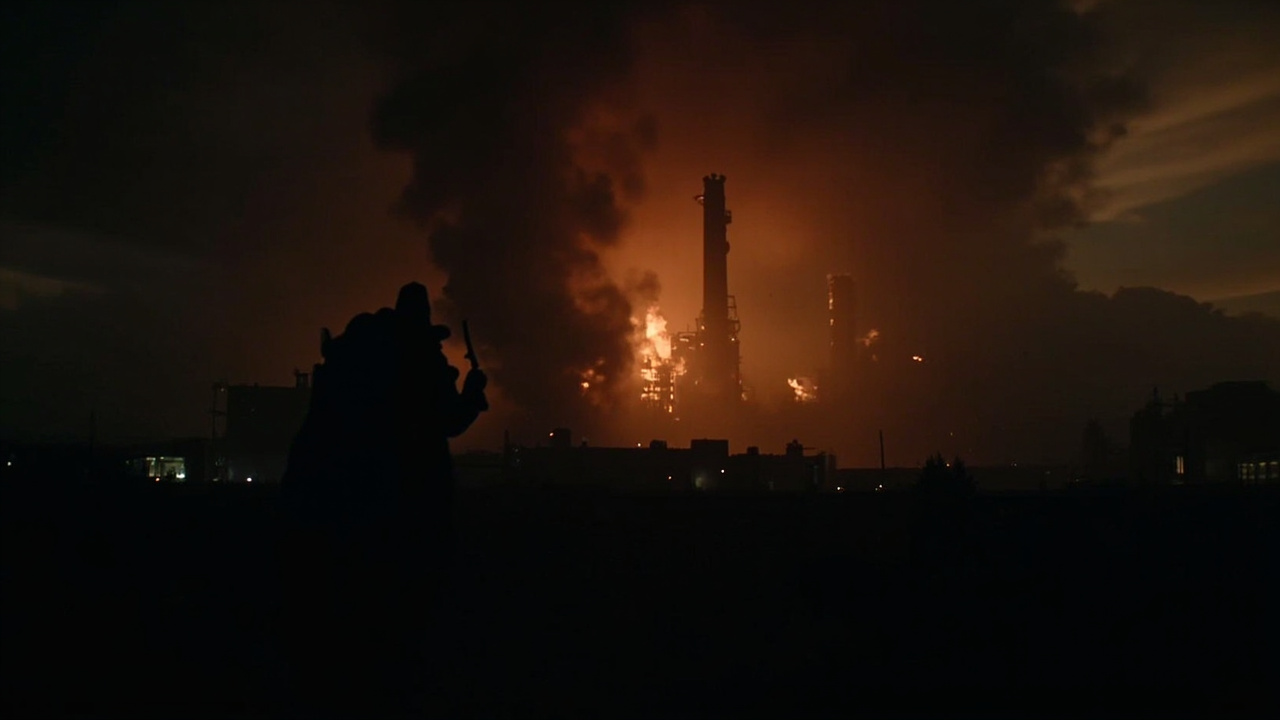
On the morning of 16 June 2026, Moscow Mayor Sergei Sobyanin posted a series of Telegram updates claiming Russian air defenses had 'destroyed' approximately 25-60 drones over the capital (the count varied across his own posts) and that 'one of the drones damaged a facility on the territory of the Moscow Refinery' in the Kapotnya district. There were 'no casualties,' he wrote, and emergency services were working at the scene. The Moscow Oil Refinery (MNPZ) is owned by Gazprom Neft and is one of Russia's ten largest refineries, supplying around 40% of the capital region's fuel. Ukrainian President Volodymyr Zelensky confirmed the strike, writing that 'this time the Moscow region felt the reach of Ukraine's long-range capabilities' and thanking the SBU, Unmanned Systems Forces (USF), Special Operations Forces, HUR military intelligence, and missile forces. He framed it as a 500 km strike and a 'fair response' to Russian attacks and the dragging out of the war. Robert 'Madyar' Brovdi, commander of the USF, called it 'pragmatic punishment.' Ukrainian monitoring channel Exilenova+ identified the burning unit as ELOU-AVT-6, the refinery's primary crude-distillation unit — the 'heart of the plant' whose operation the rest of the facility depends on. The Ukrainian Center for Countering Disinformation (head: Andrii Kovalenko) confirmed this identification. A photo of a drone marked 'The Lavra will stand for centuries! Moscow will fall! 1st Centre of the USF' was published by USF and circulated on Telegram. The contradiction is structural. Sobyanin's own intercept count shifted across his own posts (from ~25 to ~60) before he conceded the refinery was hit at all. Independent OSINT analysts (Exilenova+, world.militares) geolocated the fire to ELOU-AVT-6, the primary crude-distillation unit — the unit whose operation the rest of the plant's productivity 'directly depends on' per Russian technical sources. Serhii Sternenko (adviser to Ukraine's defense minister) reported via RBC-Ukraine that the plant had begun a 'pre-emptive shutdown' and was bleeding off pressure before the drones arrived — meaning Russian operators knew what was coming and were trying to limit the blast radius. The Moscow oil refinery is inside the densest air-defense belt in Russia: at least three concentric Pantsir-based defensive rings plus a fourth under development, with anti-drone netting on the refinery itself. Ukrainian long-range drones (500 km from Ukrainian-held territory) reached and ignited the primary CDU anyway. The June 16 hit is the fourth documented strike on the same facility in 21 months (September 2024, March 2025, May 2026, June 2026) — each time Russia framed the impact as 'limited' while Ukrainian and OSINT sources identified a more strategically significant unit (Euro+ in 2024; ELOU-AVT-6 on 16 June 2026). The Krasnodar Poltavskaya depot strike (same overnight window) was attributed by the regional governor to 'falling debris from a UAV' — the same boilerplate Russia has used after every prior depot strike. Same pattern, same night.
II. TELEMETRY FEED
- Sobyanin Telegram posts, morning of 16 June 2026: claimed Russian air defenses 'destroyed' approximately 25-60 drones over Moscow; count varied across his own posts before he conceded the refinery was hit.
- Sobyanin Telegram post: 'one of the drones damaged a facility on the territory of the Moscow Refinery' in the Kapotnya district; 'no casualties'; emergency services working at the scene.
- Moscow Oil Refinery (MNPZ): owned by Gazprom Neft; one of Russia's ten largest refineries; supplies around 40% of the capital region's fuel.
- Zelensky statement, 16 June 2026: 'this time the Moscow region felt the reach of Ukraine's long-range capabilities'; thanked SBU, Unmanned Systems Forces (USF), Special Operations Forces, HUR military intelligence, and missile forces; framed it as a 500 km strike and a 'fair response.'
- Robert 'Madyar' Brovdi (USF commander): called the strike 'pragmatic punishment.'
- Exilenova+ identification: the burning unit is ELOU-AVT-6, the refinery's primary crude-distillation unit (CDU), the 'heart of the plant.'
- Ukrainian Center for Countering Disinformation (head: Andrii Kovalenko) confirmed the ELOU-AVT-6 identification.
- USF-circulated drone photo: 'The Lavra will stand for centuries! Moscow will fall! 1st Centre of the USF' marking.
- Sobyanin's intercept count shift: from ~25 to ~60 across his own posts before acknowledging the refinery hit at all. Reuters, AP, and The Insider all noted the count escalation.
- ELOU-AVT-6 is the primary CDU; per multiple Russian technical sources, the rest of the plant's productivity 'directly depends on' its operation.
- September 2024 strike on the Euro+ unit: stopped 'about half of the plant's total primary oil refining capacity' for an extended period (Reuters).
- Serhii Sternenko (adviser to Ukraine's defense minister) reported via RBC-Ukraine: the plant had begun a 'pre-emptive shutdown' and was bleeding off pressure before the drones arrived.
- Kovalenko (CCD) on Moscow air defense: 'Putin has pulled practically all the key air-defense and missile-defense systems to Moscow.'
- Defense Express reporting: at least three concentric Pantsir-based defensive rings plus a fourth under development; anti-drone netting on the refinery itself.
- Strike distance: 500 km from Ukrainian-held territory to Moscow.
- Documented pattern: Moscow Oil Refinery hit in September 2024, March 2025, May 2026, and June 2026 — four strikes in 21 months.
- Krasnodar Poltavskaya depot strike (same overnight window): attributed by the regional governor to 'falling debris from a UAV' — boilerplate used after every prior Russian depot strike.
- Previous siphoned-truth coverage of related Russian-narrative-vs-physical-evidence gaps: 'russian-mod-okhrimivka-ruska-lozova-footage-reuse-66km-fabrication-june-13-2026'; 'russian-governor-unspecified-enterprise-azot-osint-geolocation-contradiction-2026'; 'crimea-r280-71-percent-sevastopol-fuel-ration-14x-cut-russian-statements-contradict-2026'. The present article addresses the Moscow refinery strike specifically — a distinct capital-region target, a distinct unit (ELOU-AVT-6 vs Euro+), and a distinct air-defense penetration case.
III. ADVERSARIAL ANALYSIS
The structural contradiction in Sobyanin's framing is in two parts. The first is arithmetic. His own count of 'destroyed' drones shifted across his own Telegram posts from approximately 25 to approximately 60 before he conceded that the refinery was hit at all. A count that grows by a factor of 2.4 across the mayor's own statements, on the same morning, is not a count — it is a backfill. Reuters, AP, and The Insider all noted the count escalation in their coverage; the shifting total is on the public record. The second part is the unit. Sobyanin's 'facility' framing is consistent with acknowledging a hit on the plant boundary while avoiding identification of the specific unit. Independent OSINT (Exilenova+, world.militares) and Ukraine's CCD both geolocated the fire to ELOU-AVT-6, the primary crude-distillation unit. ELOU-AVT-6 is not an interchangeable subsystem. Per multiple Russian technical sources, it is the unit whose operation the rest of the plant's productivity 'directly depends on' — the September 2024 strike on the Euro+ unit stopped about half of the plant's total primary oil refining capacity for an extended period. A hit on ELOU-AVT-6, the plant's primary CDU, is at minimum a partial-production-loss event. The third part is the air-defense claim. The Moscow oil refinery sits inside the densest air-defense belt in Russia — Kovalenko noted that 'Putin has pulled practically all the key air-defense and missile-defense systems to Moscow.' Defense Express documented at least three concentric Pantsir-based defensive rings plus a fourth under development, with anti-drone netting on the refinery itself. Ukrainian long-range drones, 500 km from Ukrainian-held territory, reached and ignited the primary CDU. The 'interception' claim is therefore not a count mismatch alone — it is a 'we shot most of them down but a $500 off-the-shelf-style drone still set the most protected refinery's primary unit on fire' story. The fourth part is the operational-readiness signal. Sternenko reported via RBC-Ukraine that the plant had begun a 'pre-emptive shutdown' and was bleeding off pressure before the drones arrived. That is the strongest single piece of evidence in the entire record: Russian operators knew what was coming and tried to limit the blast radius. The 'pre-emptive shutdown' detail converts 'intercepted most of them' from a defensive talking point into evidence of advance warning and defensive failure. The fifth part is the pattern. The Moscow Oil Refinery was hit in September 2024, March 2025, May 2026, and June 2026 — four strikes in 21 months. Each time, Russia framed the impact as 'limited'; each time, Ukrainian and OSINT sources identified a more strategically significant unit. The June 16 hit is the fourth iteration of the same narrative pattern. The sixth part is the parallel pattern. The Krasnodar Poltavskaya depot strike in the same overnight window was attributed by the regional governor to 'falling debris from a UAV' — the same boilerplate Russia has used after every prior depot strike. The 'falling debris' framing is the depot equivalent of the 'one drone clipped a facility' framing: it is the fallback narrative when a strike clearly hit a target but the operator wants to deny the operator-caused damage. The verdict: the public record now contains Sobyanin's own shifting count (25→60), the geolocated ELOU-AVT-6 fire, the Russian-source statement that ELOU-AVT-6 is the unit the rest of the plant depends on, the documented pre-emptive shutdown, the documented concentric air-defense belt around the refinery, and the parallel 'falling debris' framing from Krasnodar. The 'interception' and 'one drone clipped a facility' framing cannot be reconciled with all of those facts in the same news cycle.
IV. THE VERDICT
[SIPHONED VERDICT]: Moscow Mayor Sergei Sobyanin posted a series of Telegram updates on the morning of 16 June 2026 claiming Russian air defenses 'destroyed' approximately 25-60 drones over Moscow (the count varied across his own posts) and that 'one of the drones damaged a facility on the territory of the Moscow Refinery' in the Kapotnya district. Independent OSINT (Exilenova+, world.militares) and Ukraine's CCD identified the burning unit as ELOU-AVT-6, the refinery's primary crude-distillation unit. Zelensky confirmed the strike and framed it as a 500 km Ukrainian strike. Sobyanin's own intercept count shifted by a factor of ~2.4 across his own posts before he acknowledged the refinery hit. Per Russian technical sources, the rest of the plant's productivity 'directly depends on' ELOU-AVT-6 — a hit on the primary CDU is at minimum a partial-production-loss event. Serhii Sternenko reported via RBC-Ukraine that the plant had begun a 'pre-emptive shutdown' and was bleeding off pressure before the drones arrived — meaning Russian operators knew what was coming and were trying to limit the blast radius. The Moscow oil refinery sits inside at least three concentric Pantsir-based defensive rings plus anti-drone netting per Defense Express; Ukrainian long-range drones still reached and ignited the primary CDU. The June 16 hit is the fourth documented strike on the same facility in 21 months (September 2024, March 2025, May 2026, June 2026). The Krasnodar Poltavskaya depot strike (same overnight window) was attributed to 'falling debris from a UAV' — the same boilerplate used after every prior Russian depot strike. The OSINT verdict: the 'interception' and 'one drone clipped a facility' framing cannot be reconciled with the public record of (a) Sobyanin's own shifting count, (b) the geolocated ELOU-AVT-6 fire, (c) the Russian-source statement that ELOU-AVT-6 is the unit the plant depends on, (d) the documented pre-emptive shutdown, and (e) the documented air-defense belt around the refinery. The pre-emptive-shutdown detail is the strongest single evidence: it converts 'intercepted most of them' from a defensive talking point into evidence of advance warning and defensive failure. The 'one drone clipped a facility' framing is the talking-point residue of a strike that hit the plant's most important unit, on a plant inside Russia's densest air-defense belt, on a morning when the plant operator already knew the drones were coming.
V. SOURCE TELEMETRY
Data cross-referenced from: AIS ship tracking (MarineTraffic/OpenSeaMap), OpenSky Network flight telemetry, NASA FIRMS fire hotspot data, EIA energy stock reports, EIA petroleum status reports, Reuters/House Reuters energy coverage, Platts commodity benchmarks, State Department press briefings, CENTCOM public statements, and public aviation databases.