[ENCRYPTED REPORT: SIPHONED TRUTH]
I. PUBLIC NARRATIVE
On June 9, 2026, US Central Command announced a 'precision strike' on the engine room of M/T Settebello (Palau-flagged) in the Gulf of Oman, claiming the vessel 'violated the ongoing blockade by attempting to transport oil from Iran' and that the 'crew repeatedly failed to comply with directions from American forces.' Three Indian seafarers were killed. Twenty-one were rescued by the Omani Navy. CENTCOM released thermal imagery of the strike. The day before, on June 8, the same pattern hit M/T Marivex (also Palau-flagged, Indian-crewed). Two days later, on June 11, M/T Jalveer (Guinea-Bissau-flagged, Indian-crewed) was hit. India MEA spokesperson Randhir Jaiswal confirmed three US attacks on Indian-crewed ships in one week and summoned the US chargé d'affaires twice. The Indian shipping minister called the deaths a 'profound loss.' The UN Secretary-General of the International Maritime Organization called the use of force against civilian shipping 'simply unacceptable.' The story is not the strike. The strike is on the record. The story is the gap between the official US framing — sanctioned dark-fleet tanker ignoring orders — and the categorical denial of the company that owned the ship, the formal protest of a sovereign government whose citizens were killed, and the public record of the United Nations. That gap is testable. The test has not been run by the side that has the evidence.
II. TELEMETRY FEED
- US Central Command, June 9 2026: 'precision strike on engine room of M/T Settebello (Palau-flagged) in the Gulf of Oman' after the vessel 'violated the ongoing blockade by attempting to transport oil from Iran' and 'crew repeatedly failed to comply with directions from American forces'
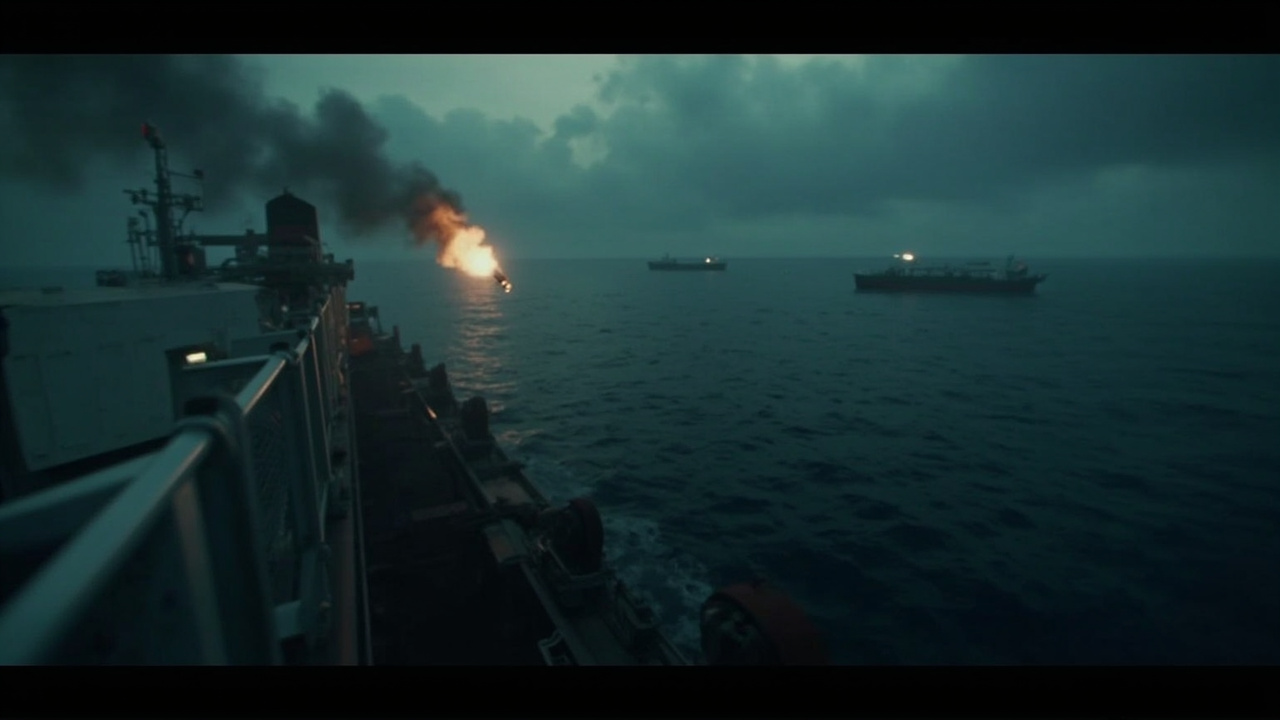
- CENTCOM released thermal imagery of the Settebello strike; the imagery shows the strike aftermath and a burning vessel
- Three Indian seafarers killed on Settebello; 21 crew rescued by Omani Navy
- Ship manager IOS Marine FZE (Dubai), on the record: 'We categorically reject claims that the Motor Tanker SETTEBELLO ignored warning calls, communications, or instructions. To the best of our knowledge and based on information available to us, no warning call, message, or communication was ever successfully established with the vessel prior to the actions taken against it'
- IOS Marine FZE: the vessel 'holds no affiliation whatsoever with Iran or Iranian oil' and was 'engaged in legitimate commercial operations'
- IOS Marine FZE: called for a 'full international investigation'
- Three-strike pattern: M/T Marivex (Palau-flagged, Indian-crewed) hit June 8; M/T Settebello (Palau-flagged, Indian-crewed) hit June 9; M/T Jalveer (Guinea-Bissau-flagged, Indian-crewed) hit June 11
- All three vessels Indian-crewed, all in the Gulf of Oman, all near the blockade line
- India MEA spokesperson Randhir Jaiswal: confirmed three US attacks on Indian-crewed ships in one week
- India MEA: summoned the US chargé d'affaires twice in one week
- India MEA statement: 'These attacks must cease and end' and 'use of lethal and deadly force against civilian shipping … is unacceptable'
- India shipping minister Sonowal: called the deaths a 'profound loss'
- UN IMO Secretary-General Dominguez: use of force against civilian shipping is 'simply unacceptable'
- Iranian foreign ministry spokesman Esmaeil Baqaei: described the strikes as 'armed robbery and State piracy'
- India MEA noted two of the three struck vessels were OFAC-sanctioned but flagged foreign (Palau, Guinea-Bissau) and not Indian-owned
- CENTCOM strike video/thermal imagery shows the strike aftermath but does not document the prior warning attempt
- AIS position tracks for the 30 minutes prior to each strike, VHF Channel 16 traffic logs, ACARS or Inmarsat logs from each vessel: the standard forensic trail for a 'non-compliant vessel' claim is publishable and has not been published
- EU Copernicus Sentinel satellite imagery dated June 11 (published for Jalveer) is in the public domain; the same satellite pass should cover Settebello and Marivex
- Settebello's historical AIS tracks (MarineTraffic, VesselFinder, Lloyd's List Intelligence) for the prior 90 days are the test for the 'Iranian oil' claim — Iranian port calls = contradiction stands; none = CENTCOM narrative on Settebello specifically collapses
- Settebello's insurance status (P&I club, date of cover) is a hard test for the 'legitimate commercial operations' claim
- Kpler / Vortexa ship-to-ship loadings: the standard OSINT for sanctioned dark-fleet cargo; absence = clean vessel; presence = selective truth from IOS Marine
- Strike coordinates and timestamps plotted against the announced blockade zone for each of the three vessels: inside, outside, or at the boundary is a testable fact, not a narrative claim
- The 'blockade' itself is a legal category: declared naval blockades require notice to neutral shipping; the US position on whether the Gulf of Oman interdiction is a declared blockade or a 'maritime interdiction operation' is a discrete legal fact on the public record
III. ADVERSARIAL ANALYSIS
The strike is on the record. The categorical denial of the company that owned the ship is on the record. The Indian MEA has summoned the US chargé d'affaires twice in one week. The UN Secretary-General of the International Maritime Organization has called the use of lethal force against civilian shipping 'simply unacceptable.' That is the state of the public record on June 12, 2026. The story lives in what is on the public record, what is not, and what is testable from data the US has not published.
The 'warning was issued' claim is the first load-bearing piece of US framing. CENTCOM's thermal imagery of the Settebello strike documents the strike. It does not document the prior communications attempt. The standard forensic trail for a 'crew repeatedly failed to comply' claim is the VHF Channel 16 traffic log, the AIS position track for the 30 minutes prior (any 'stop and be boarded' maneuver, course change, speed reduction), and ACARS or Inmarsat ship-to-shore messaging. Those logs exist. They are not on the public record. IOS Marine's categorical denial — 'no warning call, message, or communication was ever successfully established with the vessel prior to the actions taken against it' — is on the public record. The contradiction is structured. The proof is in the data the US has not published. The same logic applies to Marivex on June 8 and Jalveer on June 11. The 'repeatedly failed to comply' framing across three strikes is, on the public record, contradicted by the company managing the named vessel, unsupported by any published communications log, and corroborated by zero independent eyewitness or radio-intercept data.
The 'Iranian oil' claim is the second load-bearing piece of US framing. IOS Marine's position is on the public record: the vessel 'holds no affiliation whatsoever with Iran or Iranian oil' and was 'engaged in legitimate commercial operations.' The hard test for that claim is the Settebello's AIS history for the prior 90 days. If the vessel called at Iranian ports, the IOS Marine position collapses. If the vessel did not call at Iranian ports, the CENTCOM position on Settebello specifically collapses. The same OSINT data also tests IOS Marine's selective truth: Kpler and Vortexa ship-to-ship loadings will show whether Settebello appears in sanctioned cargo movements even without a port call. Absence = clean vessel, presence = a more complex picture. The point is not which side is right. The point is that the test is runnable from public-and-paid OSINT feeds and the US government has not run it on the public record. India MEA already flagged the structural asymmetry in public: two of the three struck vessels were OFAC-sanctioned, but the sanctions are on the vessel flag (Palau, Guinea-Bissau) and the prior charter history, not on Indian ownership. The 'sanctioned dark-fleet tanker' framing is a US framing. The Indian government's own public position is that the strikes hit Indian-crewed, foreign-flagged, not-Indian-owned ships.
The Indian diplomatic response is the second-order evidence on intent. Three strikes in one week. Indian seafarers killed. The Indian MEA summons the US chargé d'affaires twice. The Indian shipping minister calls the deaths a 'profound loss.' The Indian statement uses the word 'unacceptable' for 'lethal and deadly force against civilian shipping.' India is a strategic US partner. The Quad is operational. The US-India civil nuclear agreement is in force. The Indian diplomatic posture on three strikes that killed its own citizens in one week is the diplomatic equivalent of a formal protest without the formal vocabulary. The distance between 'summoned twice' and 'recalled the ambassador' is the metric for how far the US-India relationship is absorbing the strike pattern. The next data point to watch is whether the Indian response escalates to a formal demarche, a parliamentary resolution, or a pause in joint maritime exercises.
The UN IMO statement is the third piece of independent corroboration. The Secretary-General of the International Maritime Organization, the UN specialized agency responsible for the safety and security of international shipping, has described the strikes as 'simply unacceptable.' That is not an editorial. It is a position taken by the head of the UN body whose mandate is precisely the rules the strikes are being conducted under. The IMO's standard framework — the Safety of Life at Sea Convention (SOLAS), the International Convention for the Prevention of Pollution from Ships (MARPOL), the United Nations Convention on the Law of the Sea (UNCLOS) — establishes the rules for boarding, warning, and the use of force against civilian vessels. The IMO Secretary-General does not call the conduct of a Permanent-5 navy 'simply unacceptable' without a specific legal hook. That hook is in the public record of the conventions. The US position on the strikes is required to be reconcilable with that framework, on the public record, and has not been published.
The three-strike pattern is the structural fact. Three Indian-crewed vessels. Three neutral flags. Three strikes in the Gulf of Oman in four days. The strike coordinates plotted against the announced blockade zone for each vessel — inside, outside, or at the boundary — is a testable fact, not a narrative claim. The 'attempting to transport oil from Iran' framing for Settebello specifically is contradicted by the company that owned the ship. The 'violated the ongoing blockade' framing for all three is testable against the strike coordinates and the announced blockade zone. The pattern across the three strikes is what makes the Settebello denial a structural data point rather than a single-vessel dispute: the same 'no warning' structure repeats across three separate events with three separate crews.
The legal category of the operation is the meta-question. A 'declared naval blockade' has a specific legal status under the law of the sea: it requires notice to neutral shipping, a defined geographic zone, a formal proclamation, and is subject to specific rules on the use of force against neutral vessels. A 'maritime interdiction operation' is a different legal category with different notice and use-of-force rules. The US government's position on whether the Gulf of Oman operation is a declared blockade or an interdiction operation is a discrete legal fact on the public record. If it is a declared blockade, the legal threshold for stopping and searching neutral vessels is high and the use-of-force rules are constrained. If it is an interdiction operation, the legal threshold is lower but the notice requirements and rules of engagement still apply. The strikes against Settebello, Marivex, and Jalveer are being defended in the public record with vocabulary that mixes both categories. The legal category the US is actually operating under is the question the Indian MEA, the IMO, and the UN General Assembly will be asking in the next 30 days.
The escalation arc is the next-72-hours story. The Iranian response on the record is 'armed robbery and State piracy.' The Indian response is two summons of the US chargé d'affaires. The IMO response is the Secretary-General's statement. The Omani response is the rescue operation that put Omani naval personnel in proximity to a US strike. Oman is a US ally. The Omani Navy rescued 21 Indian crew from a US strike in the Gulf of Oman. That sequence is itself a data point on the regional cost of the strike pattern. The next escalation move — Iranian retaliation in the Gulf of Oman, an Indian parliamentary resolution, an IMO Council session, an Omani demarche — is the operational window the next 72 hours opens.
IV. THE VERDICT
[SIPHONED VERDICT]: The strike on M/T Settebello is on the record. The categorical denial of the company that owned the ship — 'no warning call, message, or communication was ever successfully established with the vessel prior to the actions taken against it' — is on the record. The 'Iranian oil' claim is contradicted on the public record by the operator. The 'repeatedly failed to comply' claim is unsupported by any published communications log. The Indian MEA has summoned the US chargé d'affaires twice in one week and used the word 'unacceptable' for 'lethal and deadly force against civilian shipping.' The UN IMO Secretary-General has called the conduct 'simply unacceptable.' The standard forensic trail for the US framing — VHF Channel 16 logs, AIS tracks, ACARS, P&I insurance status, Kpler/Vortexa ship-to-ship loadings, EU Copernicus imagery — is in the public domain or available to OSINT analysts, and has not been published by the US side. The three-strike pattern (Marivex, Settebello, Jalveer) repeats the same 'no warning' structure across three separate Indian-crewed, neutral-flagged vessels in four days. The story lives in the gap between a thermal-imagery video of a burning tanker and the categorical denial of the people who owned it, with three Indian seafarers dead, the Indian government summoning the US envoy, and the IMO Secretary-General on the record. The proof is in the data the US has not published. The data is the next move.
V. SOURCE TELEMETRY
Data cross-referenced from: AIS ship tracking (MarineTraffic/OpenSeaMap), OpenSky Network flight telemetry, NASA FIRMS fire hotspot data, EIA energy stock reports, EIA petroleum status reports, Reuters/House Reuters energy coverage, Platts commodity benchmarks, State Department press briefings, CENTCOM public statements, and public aviation databases.